From browsers to bots, search is changing. Dramatically.
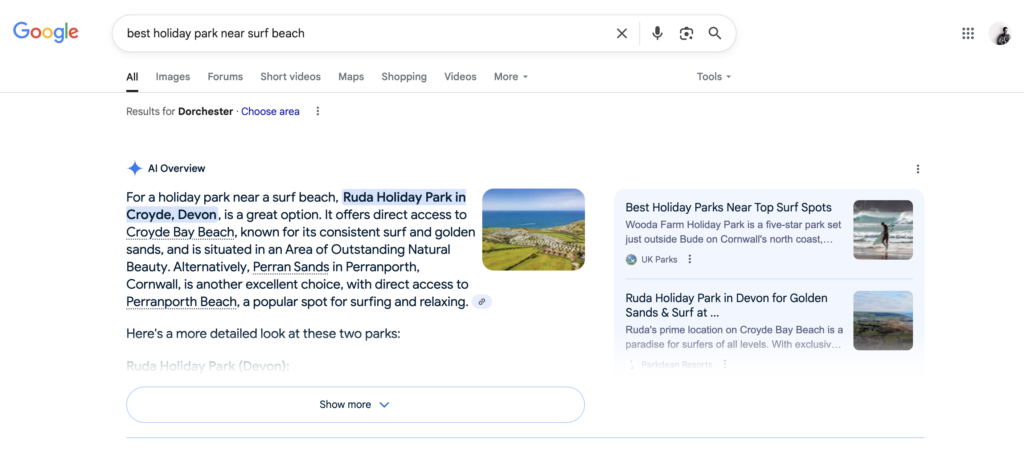
For years, the online customer journey started in a familiar place: an Internet browser. People typed in keywords, browsed links, visited websites, got tracked by a pixel (Facebook or others), and entered the funnel. Businesses invested heavily in SEO, blog content, backlinks, and landing pages; because that’s how humans searched, clicked, and converted.
But that era is being disrupted by a quiet revolution: AI search.
Whether it’s ChatGPT, Google Gemini, Perplexity, or Claude, millions of users are now turning to AI tools – NOT browsers – to find answers, discover products, and make decisions. And that fundamental shift in behaviour is changing how businesses need to think about discoverability, marketing, and conversions.
Let’s explore what this shift means, how AI is rewriting the rules of search, and what you can do today to stay visible in this new AI-first landscape.
The Rise of AI Search: A Better Consumer Experience
For years, guests planning a holiday would start their journey with a browser. They’d search “Lake District family holiday park” or “dog-friendly glamping near Cornwall,” click through a list of websites, and manually compare options. It was time-consuming and often frustrating.
AI search changes everything.
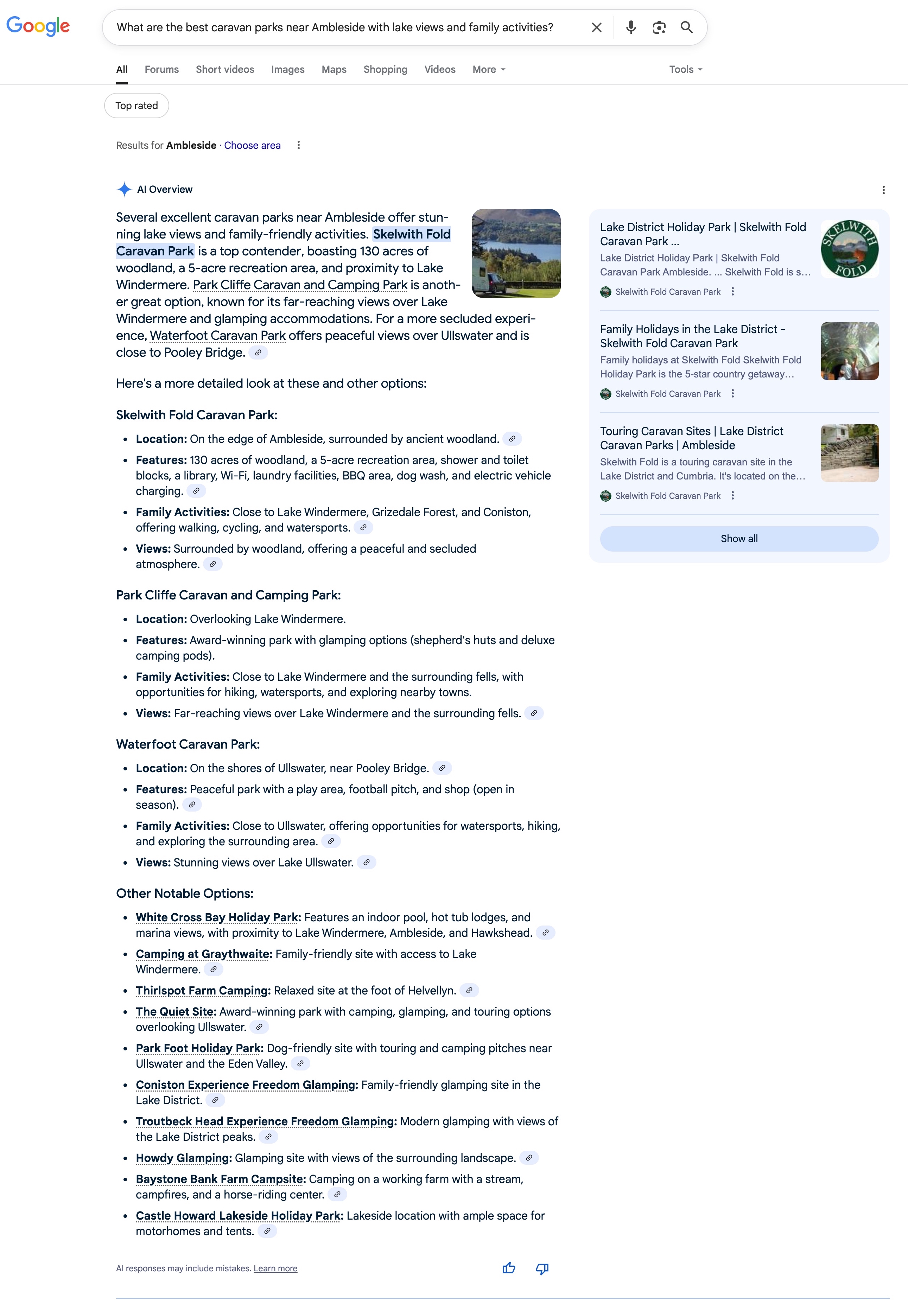
Now, a guest can ask Google of ChatGPT, “What are the best caravan parks near Ambleside with lake views and family activities?” – and receive a direct, curated list in seconds. No long search engine results, no multiple tabs. Just relevant, immediate answers.
This shift is especially important for hospitality and holiday park businesses, where the booking journey is often emotional, time-sensitive, and influenced by countless variables like location, amenities, season, and family preferences.
Guests aren’t browsing any more, they are asking AI agents to do the research for them.
And that means your business might be recommended, summarised, or excluded before a potential guest ever lands on your website. It’s faster, more efficient, and frankly a better experience for the user. Which is why AI Search is becoming the new front door for travel discovery.
We’re now outsourcing our browsing to AI. And that means your business needs to stop optimising just for people and start optimising for AI agents – because they are becoming the gatekeepers between you and your customers.
Why Traditional SEO Isn’t Enough Anymore
Search engine optimisation isn’t dead – but it is evolving fast.
AI models don’t crawl and rank content the same way Google’s algorithm does. They interpret intent, synthesise meaning, and pull from a wider pool of sources. And that includes blogs, reviews, forums, and third-party sites to form a response.
That means:
- Your brand might not appear in an AI answer even if you rank on Google.
- Third-party content is often prioritised to provide an “unbiased” view.
- AI crawlers are the new primary consumer of your website content.
SEO is evolving but still essential
While traditional SEO is no longer the only game in town, it remains a critical foundation for AI search visibility. But the tactics are changing.
Forget keyword stuffing and overly optimised metadata. Today’s search landscape—driven by large language models rewards content that prioritises user intent and relevance, not just content optimisation.
AI is reading and interpreting content more like a human than a robot, and it is synthesising answers from across the web.
Here’s what that looks like in practice:
- Write for Both AI and Humans
Your content should be clear, helpful, and well-structured. AI models favour content that mirrors how real people speak and think, so aim for depth, clarity, and natural language that answers questions directly. - Leverage Long-Tail Content
Niche, focused topics often perform better in AI search responses. A well-written blog on “dog-friendly static caravan holidays near Windermere” is more likely to be cited by AI than a generic “UK holiday parks” page, especially for smaller brands looking to compete with bigger names.
Ultimately, AI models are trained on high-quality language. The more relevant, useful, and well-written your content, the more likely it is to be surfaced in an AI-generated answer.
Importantly, don’t keyword stuff. Focus on writing for intent, not just for SEO. AI is looking to answer a human question – so make sure you provide the answer.
What Businesses can do to be found in AI Search
This shift is not just a search engine update. It’s a fundamental rethinking of how customers discover, evaluate, and trust brands.
Here’s how to stay ahead:
- Monitor How Your Business is Represented in AI
Start by manually querying AI tools like ChatGPT, Gemini, Perplexity, and Claude. Ask the kinds of questions your ideal customers would ask. Tray searching for your sector, your competitors, and even about your brand.
Are you showing up? If so, how? If not, who is?
You can also review your web logs and Google Analytics GA4 to track visits from AI crawlers and measure referral traffic from these tools. Early data suggests that AI-sourced traffic converts at 2-5x higher than traditional organic traffic. The reason being, the decision-making already happened in the chat.
- Stop Blocking AI Crawlers
Many companies, out of fear of data misuse, are blocking AI crawlers. This can backfire badly. If you block Google’s AI bots, you may also be blocking your content from appearing in Search Generative Experiences (SGE). If AI tools can’t access your website, they will form opinions based on third-party sources, and those may not be accurate.
If you want to be part of the AI-driven future of search, you must let the bots in.
- Create AI-Friendly Content
Large Language Models crave language. The more clear, structured, and relevant content you provide, the better your brand will be represented in AI search.
What to create:
- Educational content (FAQs, glossaries, guides)
- Top-of-funnel content (even if it is for the bots and not for a human directly)
- Clear descriptions of products, services, and categories
- Content that explains your brand in plain English
- Leverage Third-Party Content and Reviews
AI relies heavily on external sources to build trust and context.
That includes:
- Review sites
- Forums
- Media articles
- Influencer blogs
- Product round-ups
- Industry directories
For non-branded searches (e.g., “best PMS for holiday parks”), AI models may prioritise unbiased third-party content over your website. So, invest in ensuring your brand is accurately and positively represented across the web.
This can mean:
- Contacting partners that reference your brand and website to update product descriptions
- Submit corrected information to directories
- Sponsor thought leadership pieces or whitepapers
- Building affiliate relationships
- Think of AI as a new Buyer Persona
In the new age of search, your “broker to the buyer is the AI crawler.”
AI tools are the new influencers. They read your content, interpret your brand, and present you (or your competitors) to potential customers. That makes AI not just a search engine, but a customer of your content.
If you think that way, it will change how you structure your site, how you write your copy, and how you measure success.
Is this just a trend?
No. This is the new way the Internet works.
Google is embedding AI Overviews in nearly every search. OpenAI is building its own search index. Perplexity and Claude are rapidly expanding user bases. And customers (both consumers and B2B buyers) are forming opinions and making decisions without ever visiting your website.
This isn’t a beta phase. This is a paradigm shift.
Don’t Wait to Adapt
If your customers are already using AI to search (and they are) you can’t afford to ignore this any longer. The brands who adapt early will gain visibility, trust, and conversions. The ones who wait will find themselves invisible in a world where the first impression is made by a chatbot, not a browser.
So, start today:
- Audit your content.
- Open your site to AI crawlers.
- Update third-party sources.
- Rethink your funnel.
- And most importantly, show up where your customers are already looking – in AI Search.
Want to stay ahead in this AI-first era of search – talk to the Key Digital team of tech and travel experts and we will help you.